What Is the MIAH Program?
The MIAH program offers structured training in artificial intelligence, with ethics as its guiding thread. Student training begins in kindergarten, with age-appropriate content, and continues throughout elementary school.
In high school, rather than simply teaching the technical aspects of AI, MIAH places ethical reflection at the centre of learning. In the first cycle, students acquire the fundamentals (AI vocabulary, how it works, coding, algorithmic bias, cybersecurity and digital citizenship). In the second cycle, reflection broadens: students analyze deepfakes, disinformation and explore the political, economic and professional dimensions of a transforming world.
Why This Program Matters
Our students are the first generation to grow up in a world surrounded by artificial intelligence. They use AI tools daily (voice assistants, recommendation platforms, generative tools) often without an ethical framework or a real understanding of how they work. This same generation will soon have to make collective decisions touching on issues as fundamental as democracy, social justice and health.
Since the rise of large language models in 2022, the pressure on the educational sector has intensified. Existing approaches, often limited to digital citizenship or technical aspects, are no longer sufficient. We need to go further: training young people capable of analyzing, questioning and acting in an informed way, in the face of AI.
The MIAH program directly addresses the orientations of Québec’s Ministry of Education 2026 Digital Competency Reference Framework, which explicitly integrates AI and generative AI in all its dimensions. Designed in 2019, this program anticipated these orientations and now goes beyond baseline expectations, by placing ethical judgment at the heart of every module.
Program Overview
The MIAH program, designed by a visionary pedagogical team at Collège Sainte-Marcelline, uniquely combines the technical aspects of artificial intelligence with structured ethical reflection.
The goal is not to train AI experts, but citizens who are capable of understanding these technologies, assessing their implications and making responsible decisions in a world increasingly shaped by AI.
An Integrated Approach
Each module combines a technical component (know-how) and an ethical component (soft skills). Technology is never presented without reflection on its implications.
Spiral Progression
Several major themes such as bias, transparency and social impact, are revisited at each level with increasing complexity.
Grounded in Reality
Through current events, concrete cases, students’ personal experiences and ethical dilemmas drawn from life situations, each session allows students to build their competencies in the use and challenges of AI.
A Guided Approach
Rather than banning or ignoring AI, the program chooses to frame it: training students to use AI consciously and responsibly.
MIAH Certification
At the end of the five-year journey, students receive an official certification attesting to their ethical AI competencies.
Ministry Alignmen
The program is fully aligned with the PFÉQ and covers all 12 dimensions of the MEQ 2026 Digital Competency Reference Framework.
Integration into the Course Schedule
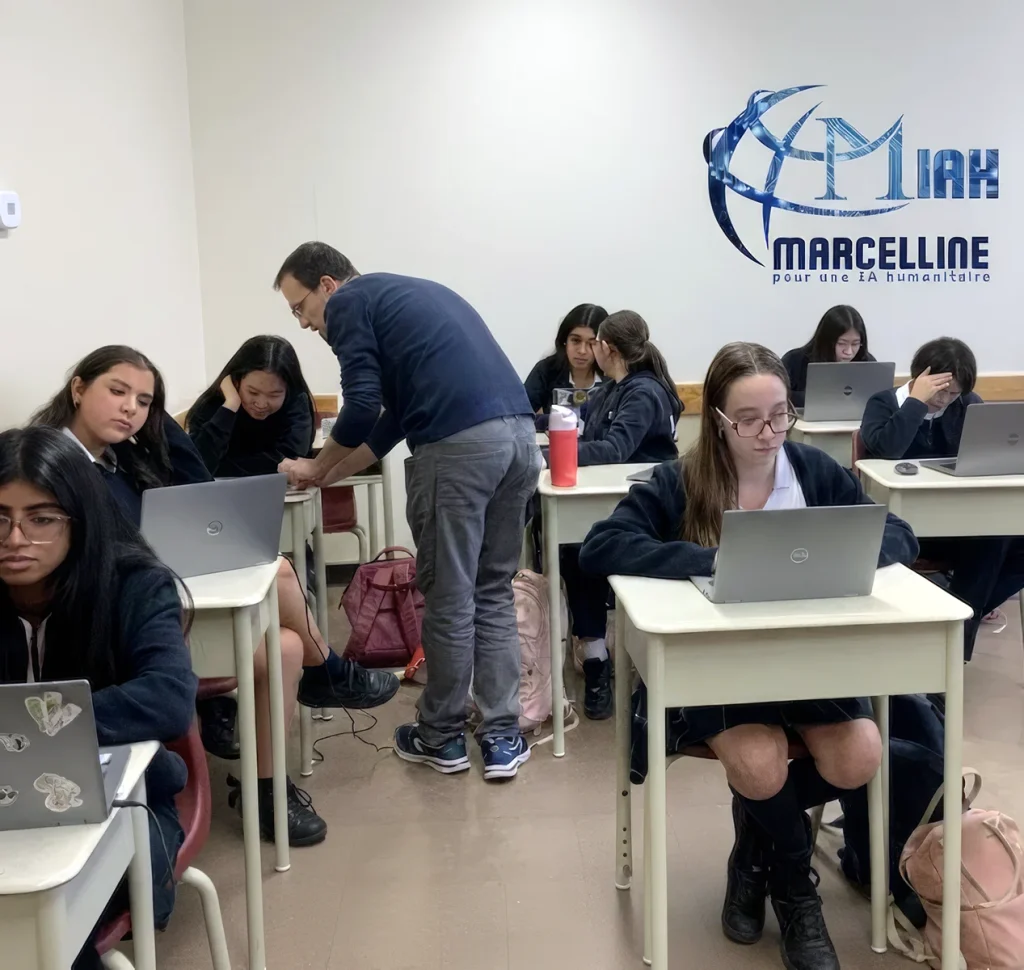
The MIAH program has a dedicated slot in the curriculum, on equal footing with other disciplines. This continuous instruction ensures progression in learning and allows students to develop in-depth thinking that endures over time.
Dedicated Human Resources
An AI educational advisor coordinates the program, monitors technological developments, creates content, and provides support to the team. A lead teacher develops and implements the content at each level in accordance with the established curriculum. Teachers at each grade level receive initial training and ongoing support. External experts and partners (researchers, AI professionals, and specialized organizations) also contribute to the team’s discussions and the development of the curriculum.
Pedagogical Approaches
The program draws on a variety of methods: analysis of ethical scenarios inspired by current events, structured debates, guided experimentation with AI tools, integrative projects and metacognitive reflection on students’ own use of AI. Assessment is both formative and summative, based on student work, journals, argumentative essays, and mini-integrative projects at the end of each grade.
Developed Competencie
The MIAH program is structured around two main competencies that complement each other and provide the framework for the students’ entire academic journey. These competencies are integrated throughout each course module.
Competency 1 — Using AI Tools in an Informed Way
This skill helps students understand the basic mechanisms of AI, use and compare generative AI tools, and evaluate the reliability and relevance of their results. They learn to choose the appropriate tool based on the context and to formulate precise and effective prompts..
Competency 2 — Exercising Critical Judgment About AI
This competency develops the ability to recognize ethical issues related to AI, to analyze its impacts on oneself, others and society, and to formulate a well-reasoned and defensible position. Students adopt responsible behaviours and learn to act as ethical citizens in the age of AI.
A Progression from Grade 7 to Grade 11
The program follows a structured progression: the big questions of AI are addressed from Grade 7, then revisited each year with increasing depth. Each level corresponds to a distinctive intellectual posture.
Grade 7 — Discovering AI
Students develop their first representations of AI, learn to recognize algorithms in their daily lives and begin to question the biases and ethical choices hidden behind machines.
Grade 8 — Exploring AI
Students deepen their understanding of how AI systems work, discover generative AI, documented biases, the environmental impact of digital technology and examine their own relationship to AI and platforms.
Grade 9 — Analyzing AI
Students take a well-reasoned stance on complex issues, such as automated decision-making, disinformation, and creativity in the context of generative AI. They examine power dynamics and reflect on the role of AI in serving humanity.
Grade 10 — Evaluating AI
Students examine the major social transformations linked to AI (labour market, health, geopolitics) and explore regulatory mechanisms. They design an integrative project proposing a responsible solution to a real problem.
Grade 11 — Projecting AI
Each student draws a reflective assessment of her journey, questions her identity in the age of algorithms and crafts her personal manifesto: a public statement on the values she upholds in a world transformed by AI.
Award and Recognition
May 2026 — Winner in the “Transformation of the Traditional School Model” category at the 9th edition of the Innovation Award from the Fédération des établissements d’enseignement privés (FÉEP).
The school won the award in the most prestigious category of the FÉEP Innovation Awards — “Transformation of the Traditional School Model” — for the MIAH ethical AI program.
This provincial distinction highlights the pioneering, bold and deeply innovative nature of this unique program in Québec. The jury also praised the depth and rigor of the ethical and pedagogical analysis, recognizing the program as exceptional.
A provincial distinction that confirms what the school has been championing since 2019: AI ethics is not optional — it is a necessity.