What Convinced Us to Act in 2019

Our children will be the first generation to live in a world surrounded by artificial intelligence. This same generation will have to make societal choices in the years to come. These decisions will touch on issues as important as economic inequality, health and even democracy. We want to ensure that children have the skills required to make informed and ethical decisions in today’s and tomorrow’s world. Current discourse on AI tends to present this technology as either a saviour or a threat to society as we know it. In reality, this will depend on how we collectively decide to use it. That is why time is of the essence. It is essential that government, educational institutions, industry and society as a whole work together to ensure that the instruction of children is a central issue in discussions about AI. It is our duty to teach our children to work with artificial intelligence, not against it, to build a better future.
Yoshua Bengio et al., La Presse, April 5, 2019 — Turing Prize laureate, founder of Mila and LoiZero
A Program That Starts in Kindergarten
At Collège Sainte-Marcelline, digital skills and computational thinking are introduced from the earliest age, progressively, in age-appropriate ways, and integrated into each grade’s schedule.
From kindergarten through Grade 11, the MIAH program accompanies every student in developing a conscious and responsible relationship with artificial intelligence. Content evolves with age, but the guiding thread remains the same: understand, question and act in an informed way.
A Continuous Progression from Elementary to High School
In elementary school, learning progressively deepens understanding of the digital world through activities covering ten essential dimensions: ethical citizenship, technological skills, information literacy, collaboration, communication, creativity, inclusion and problem-solving.
In high school, ethical reflection takes centre stage. Each academic year is centred on a distinctive intellectual posture: discover, explore, analyze, evaluate, project. Rather than simply learning to use AI, students learn to understand it, question it and use it responsibly.
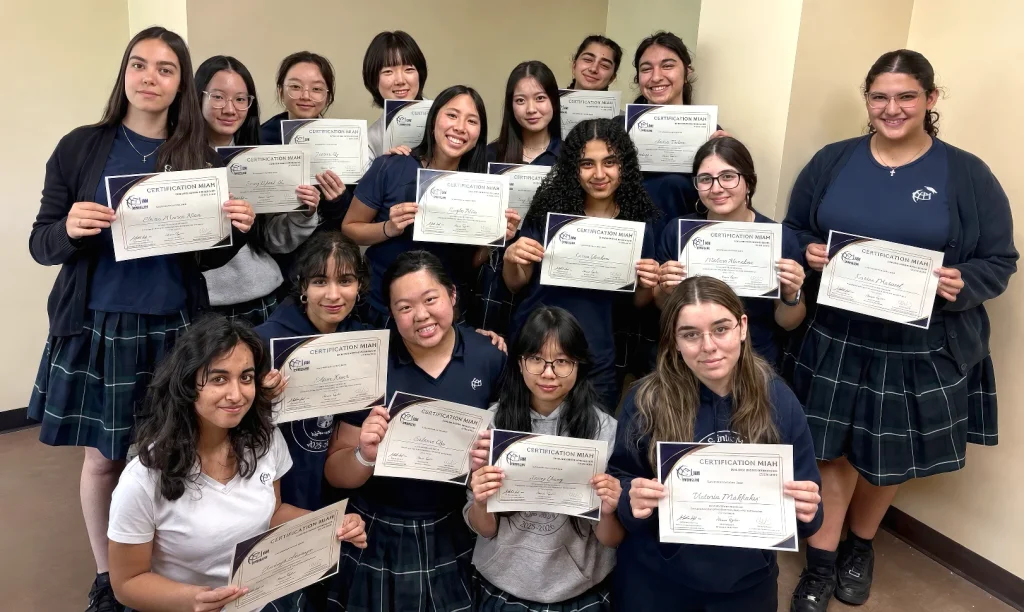
At the end of the five-year journey, an official certification attests to the competencies acquired in ethical AI.
Two Core Competencies
The MIAH program is built around two complementary competencies:
Using AI Tools in an Informed Way
Understanding the basic mechanisms, using and comparing generative AI tools, evaluating the reliability of results, and formulating precise and effective queries.
Exercising Critical Judgment About AI
Recognizing ethical issues, analyzing impacts on oneself and society, building an argued position and acting as a responsible citizen in the age of AI.