
Filing a Complaint: Three Steps
If you are dissatisfied with the educational services received, a student or their parents may file a complaint following this procedure:
Step 1 — Contact the Staff Member in Question or Their Direct Supervisor
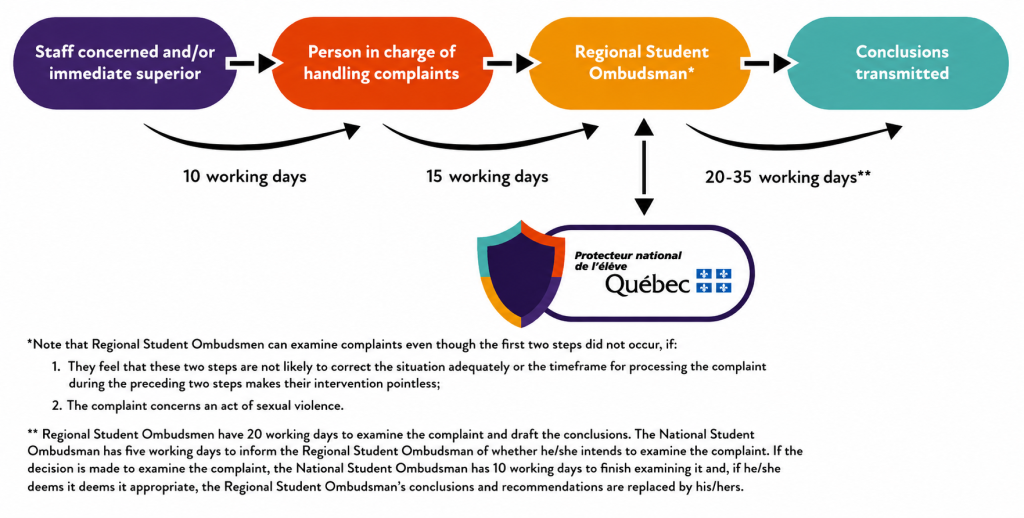
The student or parent first contacts the staff member in question or their direct supervisor. The complaint may be verbal, but it is preferable to submit it in writing. A period of 10 working days is granted for a follow- up.
Step 2 — Complaints Coordinator
If dissatisfaction persists or the 10-day period has elapsed, the student or parent may contact the school’s Complaints Coordinator.
The complaint may be verbal, but it is preferable to submit it in writing. A period of 15 working days is granted to follow up.

Nadia Sanmiguel
Step 3 — Regional Student Ombudsman
If dissatisfaction persists or the 15-day period has elapsed, the student or parent may contact the Regional Student Ombudsman, who will assist them in formulating their complaint in writing.
Phone or text: 1 833 420-5233
The Regional Student Ombudsman has 20 working days to review the complaint. If the complaint is found to be substantiated, recommendations will be made to the school. The National Student Ombudsman then has 5 working days to decide whether to examine the complaint in turn, and 10 days to complete the review.
The school has 10 working days to inform the complainant of the actions taken in response to the recommendations.
Reporting an Act of Sexual Violence
A report differs from a complaint: it concerns facts witnessed, not experienced as a victim. Any person may report an act of sexual violence committed against a student.
The following may submit a report: a teacher, a school professional, an employee or member of the administration team, another student or their parents.
Reports are treated urgently. The confidentiality of the reporting person is protected, except with their consent or as required by law.
Submit a Complaint
Phone or text: 1 833 420-5233
Protection From Retaliation
Any person who files a complaint, reports an incident, or assists in its investigation is protected from retaliation. It is prohibited to threaten anyone to prevent them from filing a complaint.
For a student or their parents, the following are presumed to constitute retaliation: depriving them of their rights, applying differential treatment, or suspending or expelling a student.
For staff, the following are presumed to constitute retaliation: demotion, suspension, dismissal, reassignment or any disciplinary measure.
Fines for retaliation range from $2,000 to $20,000 for an individual, and from $10,000 to $250,000 for a legal entity.